
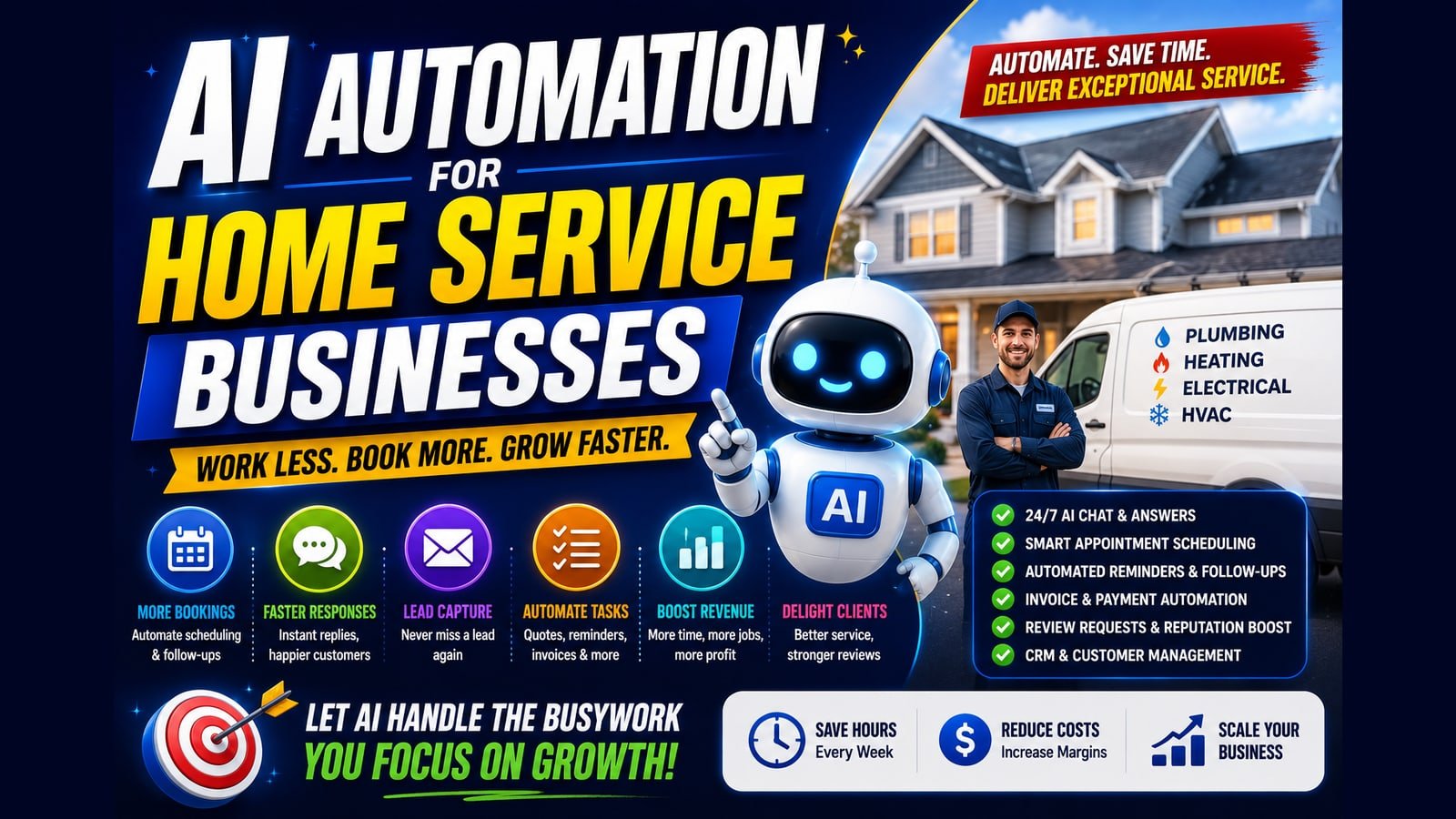
AI automation for home service businesses is an easier case to make than for almost any other industry, and for a reason that has nothing to do with technology. Demand in the trades arrives unscheduled, often urgent, and almost always by phone — at the exact moment the person who could answer it is on a roof, under a sink, or driving between jobs. The gap between an enquiry arriving and someone responding is where the revenue goes. This post covers what to automate first across HVAC, plumbing, roofing, electrical and the rest, what the honest limits are, and which parts of the job should stay human permanently.
Key takeaways
- In the trades a slow response usually loses the whole job, not a slice of conversion — the customer has already booked someone else.
- Missed-call text-back is the highest-return automation available to most home service businesses, and the cheapest to deploy.
- Voicemail is not coverage. An urgent caller hangs up and dials the next company rather than leaving a message.
- Cost per-usage pricing against your worst week, not your average one — peak weeks are exactly when the system earns its keep.
- Never automate the price on a job that needs eyes on it, and never automate emergency triage without a human path.
- Run missed-call capture alone for thirty days against a measured baseline before adding anything else.
Why the trades are a stronger case than most industries
Most businesses automate to save time. Home service businesses automate to stop losing jobs, which is a different and much easier argument to win.
Three things make the case unusual. First, demand is genuinely unpredictable — nobody schedules a burst pipe, and a heatwave produces a week of calls that looks nothing like the month before it. Second, the person best placed to answer the phone is structurally unable to, because they are doing the billable work. Third, and most importantly, the buying decision is almost always won by whoever responds first. A homeowner with water coming through the ceiling is not comparing quotes. They are calling down the list until a human answers.
That last point is what makes the arithmetic here different. In most industries a slow response costs you some conversion rate. In home services a slow response frequently costs you the entire job, because the customer has already booked someone else by the time you call back. The loss is total, and it never appears in any report — you cannot see the jobs you never knew about.
The missed call is the whole problem
If you only fix one thing, fix this. For most home service businesses the single largest automation return available is capturing the calls that currently go nowhere.
Work out what it is worth before deciding anything else. Take your average job value, multiply by your close rate on inbound calls, and multiply that by the number of calls per week that ring out, go to voicemail, or arrive after hours. That figure is what the gap costs you every week. For most established trades businesses the number is uncomfortable, and it is the reason this sits above every other automation in the list.
The important detail is that voicemail does not solve it. A homeowner with an urgent problem does not leave a message and wait — they hang up and call the next result. Voicemail feels like coverage and functions as a slower way to lose the job. What actually works is either an immediate automated text back to the missed number, which converts a dead call into a live conversation within seconds, or a voice agent that answers on the first ring and books the slot outright.
The text-back version is the cheaper of the two and, for a lot of businesses, most of the win. It is close to trivial to set up, it costs very little per message, and it changes the caller's experience from being ignored to being acknowledged before they have finished dialling the next company.
Everything above — the phone, the calendar, the records and the follow-up in one place — is what we build with GoHighLevel systems for home service businesses, configured to the trade rather than dropped in as a template.
What to automate, in the order that pays
This sequence is deliberate. Each one is cheaper and more certain than the one after it, and each is useful on its own — you do not need the whole stack for any single piece to work.
- Missed-call text-back. Any call that rings out gets an immediate message offering to book or asking what they need. Highest return per pound spent, and it can be live the same week.
- After-hours and overflow answering. A voice agent picks up when nobody can, captures the job details, flags genuine emergencies, and books everything else into the diary. This is coverage, not replacement — the phone still rings for whoever is free.
- Booking, confirmation and reminders. High volume, almost no variation, and a measurable cost per no-show. The payback arithmetic on this one is usually the easiest to prove.
- Quote and estimate follow-up. The task every trades business intends to do consistently and nobody does, because chasing a quote competes with the actual job for attention. A three-touch sequence over two weeks recovers work that would otherwise go quiet.
- Review requests after job completion. Triggered when the job is marked done, sent while the customer still remembers the work. Compounding return, near-zero effort, and it runs at exactly the moment a human is least likely to remember.
- Reactivation of old customers. A boiler serviced two years ago is due. A roof inspected before last winter is worth a message before this one. This is the cheapest lead source most trades businesses already own and never use.
Seasonality is the part generic advice misses
Almost every article about automating a business assumes steady volume. The trades do not have steady volume, and the difference matters for how you build.
HVAC has two peaks a year and a quiet middle. Roofing spikes after storms with no notice at all. Plumbing runs closer to flat but produces emergency clusters in cold snaps. The consequence is that your automation has to handle a week where call volume triples without warning, and then sit mostly idle for two months.
This cuts two ways. It strengthens the case, because a peak week is precisely when calls get missed and when an extra human is impossible to hire at short notice — a voice agent that answers forty calls in a morning does not care that it is forty. But it also means per-usage pricing needs checking against your worst week, not your average one. A system costed against a normal month can produce a bill you did not expect during the week it was most useful.
It also changes what reactivation is worth. A pre-season message to last year's customers, sent three weeks before the peak rather than during it, moves work into the quiet period and takes pressure off the week you cannot staff. That is a scheduling gain as much as a marketing one, and it is available to any business with a customer list and the discipline to send it.
What does not work in the trades
These fail for structural reasons specific to this industry, and they fail more reliably the smaller the operation is.
- Automated quoting for anything that needs eyes on it. A price given before someone has seen the job is either padded enough to lose the bid or low enough to lose money. Automate the follow-up and the scheduling of the visit — not the number.
- Fully automated emergency triage with no human path. Deciding what counts as an emergency carries real liability, and a system that downgrades a gas smell or a live electrical fault to a next-day slot is a problem no efficiency gain covers. Route urgency to a person, always.
- Automated dispatch built on a schedule nobody actually follows. Routing and assignment tools assume the diary reflects reality. In most small trades businesses it does not — jobs overrun, engineers swap, someone takes a cash job. Fix the scheduling discipline first or the automation makes the mess faster.
- Chatbots as the primary contact route. This customer is calling, frequently one-handed, sometimes standing in water. A chat widget is the wrong channel for the moment of need, whatever it does for your website metrics.
- Review automation that fires before the job is genuinely finished. Asking for a rating while the customer is still waiting on a part is how you collect the review you did not want.
What the stack actually looks like
You need fewer moving parts than most vendors suggest. Three things, and most businesses in this trade already pay for one or two of them.
A place where customer records and job history live, so a message can reference what was done last time and when. A booking calendar that reflects real availability rather than an aspirational version of it. And something that sits between the phone, the calendar and the records, and moves information between them without anyone retyping it.
The mistake worth avoiding is buying five specialist tools that each solve one item on the list above and none of which talk to each other. That produces a review request that fires for a cancelled job, a reminder for an appointment that moved, and a reactivation message to someone who called last week — all of which are worse than sending nothing, because they tell the customer you are not paying attention. A single environment where the phone, calendar, records and messaging share one view of the job avoids the entire category of error.
For most home service businesses this is the argument for consolidation over best-of-breed. The individual tools may be marginally better in isolation. The integrated version is the one that does not embarrass you in front of a customer.
How to start without betting much
Start with missed-call text-back, on its own, for thirty days. It is the cheapest item on the list, the fastest to deploy, and the one whose result is unambiguous.
Before you switch it on, count the baseline for a week: how many calls come in, how many are answered, how many ring out, and roughly what a job is worth. This takes very little effort and it is the step almost everyone skips, which is why so many trades businesses cannot say whether the tool they bought did anything.
After thirty days, compare answered-and-recovered calls against the same week's volume. If the recovered work exceeds what the system costs — and for most established businesses it does, quickly — you have a documented result that justifies the next piece. If it does not, you have learned something real for a small outlay, which is the point of starting here rather than with a full build.
Then add the next item in the order above, one at a time, measuring each. A trades business that automates six things at once cannot tell which one worked, and when something misfires in front of a customer it cannot tell which one did that either.
Common questions
Will customers know they are talking to a machine? Some will, and it matters less than people expect when the alternative is voicemail. A caller with an urgent problem cares about being handled, not about who handled them. Where it does matter is tone and honesty — a system that pretends hard to be human and gets caught does more damage than one that is straightforward about what it is and books the job efficiently.
Is this only for larger firms with call volume? No, though the arithmetic changes. A two-van operation missing six calls a week at a typical job value is losing more than the tooling costs, and that case clears easily. What does not clear is a business with very low call volume and high job values where every enquiry is already answered personally — there, the automation is solving a problem you do not have.
How is this different from an answering service? An answering service takes a message. The systems described here book the job into a real calendar, write the details into your records, and trigger the confirmation and reminders without anyone relaying anything. The difference is whether the work continues after the call ends.
What about jobs that need a site visit to price? Automate everything around the visit and none of the pricing. Booking the survey, confirming it, reminding both sides, and chasing the quote afterwards are all repetitive and safe. The number itself stays with the person who saw the job.
Do I have to replace my field service software? Usually not. Most of these automations connect to what you already run rather than replacing it, and replacement means migration, retraining and a period where nothing works properly. That needs a stronger justification than tidiness.
How quickly can missed-call text-back be running? Days, not weeks. It is one of the few automations where the setup is genuinely quick and the main decision is what the message should say.
This post covers the whole job lifecycle, from the missed call to the review request. For the phone leg specifically — how an AI receptionist handles inbound calls — that is covered in its own post.
Related services
GoHighLevel Systems
We configure, automate, and optimise complete GoHighLevel environments — from pipelines and funnels to reputation management and sub-account structures.
Explore ghl infrastructureVoice AI Systems
We deploy AI voice agents that answer calls, qualify leads, and book appointments — at any hour, in any volume, sounding like your best team member.
Explore conversational aiCRM Automation
We turn your CRM into an intelligent revenue engine — automated pipelines, smart follow-ups, AI scoring, and reporting that shows what to do next.
Explore crm intelligence