
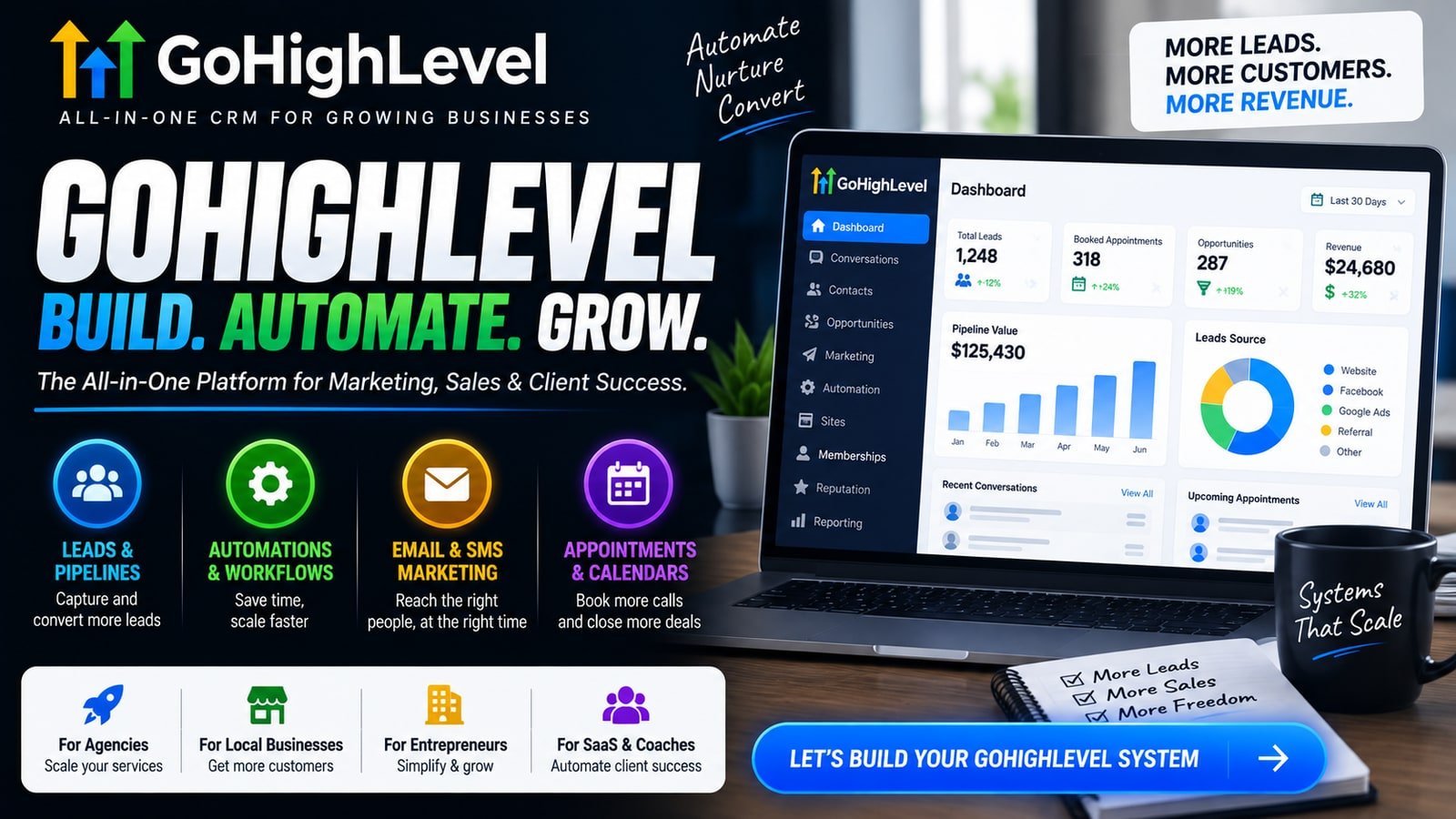
GoHighLevel — often typed as "go high level" — is one platform that replaces the six or seven tools most marketing agencies and service businesses stitch together: CRM, funnel builder, email and SMS, calendars, reputation management, phone. That bundling is the whole pitch, and for the right business it is genuinely worth the money. For the wrong one it is an expensive subscription that never gets configured. This is which is which, including the costs that do not appear on the pricing page.
Key takeaways
- GoHighLevel's own affiliate page advertises 40% recurring commissions, so most reviews online were written by someone paid monthly if you subscribe and stay — weight them accordingly.
- It bundles CRM, funnels, email and SMS, calendars, reputation management and a phone system into one flat-priced platform, built agency-first with client businesses as sub-accounts.
- Published plans are $97, $297 and $497 a month; phone, SMS and email usage are metered on top, and AI Employee is $50 or $97 a month per sub-account.
- Judge the price against the stack you would actually retire, not against zero. If you would keep half your existing tools, the math does not work.
- It fits agencies serving similar clients, agencies reselling software, and service businesses losing leads between disconnected tools — all follow-up problems, not lead-generation problems.
- Skip it if you are a solo operator with a working process, if you sell products rather than services, or if nobody at the company will own it.
- Use the 14-day trial to run one real process end to end with real leads, rather than touring features — that answers the only question that matters.
Why almost every review recommends it
Start here, because it explains most of what you will read elsewhere. GoHighLevel's own affiliate page advertises 40% recurring commissions — not a one-time payment, but a share of the subscription every month for as long as the customer stays. On a $297 plan that is roughly $119 a month, indefinitely, per referral.
That is a legitimate program and plenty of honest people are in it. But it means the overwhelming majority of reviews, comparisons and "is it worth it" videos about this product were written by someone who gets paid monthly if you sign up and stay. It is the single most important thing to know before reading any of them, and it is almost never disclosed prominently.
We build in GoHighLevel for clients. There are no affiliate links anywhere in this post — every link here goes to another page on this site, and nothing below pays us if you subscribe. Where the answer is that you should not buy it, we have said so.
The practical takeaway is not that the product is bad — it is not. It is that the ratio of praise to criticism you find online tells you about the commission structure, not about the software. Weight what you read accordingly, and be suspicious of any review that has no section on who should avoid it.
What it actually is
GoHighLevel is a single platform that does the jobs of several separate subscriptions. The core pieces are a CRM with sales pipelines, a funnel and landing page builder, email and SMS sending, appointment calendars, review and reputation management, workflow automation, and telephony through an integrated phone system.
It was built for marketing agencies first, and that origin shapes everything about it. The account structure is agency-on-top, with client businesses underneath as sub-accounts. You can build a setup once and stamp it into every new client account. On the higher tiers you can resell the whole platform under your own brand, at your own price, so your clients never see the GoHighLevel name.
That architecture is why it feels slightly odd if you are a single business using it for yourself. You are working inside a tool designed for someone managing twenty businesses, and a fair amount of what you see exists for them rather than for you.
The comparison people reach for is HubSpot or Keap, and it is misleading. Those are CRMs that added marketing features. This is a bundle assembled to replace an agency's entire tool stack, priced flat rather than per contact — which is the actual reason the economics work for the people it works for.
- CRM and sales pipelines, with unlimited contacts and users on every plan.
- Funnels, landing pages, forms and surveys.
- Email, SMS and voicemail drops, with automation sequences behind them.
- Calendars and booking, tied into the pipelines.
- Review requests and reputation management.
- A phone system, which is what makes call tracking and voice automation possible.
We build and configure GoHighLevel environments for clients, which is where the failure modes above come from rather than from a feature list.
What it costs, including what the page does not show
The published plans are straightforward. Starter is $97 a month and covers three sub-accounts. Unlimited is $297 a month, removes the sub-account cap, and lets you rebill phone and email usage to clients at cost. Agency Pro is $497 a month and adds the ability to resell the platform as your own product, mark up that usage, and reach the more advanced parts of the API. There is an Enterprise tier with custom pricing that adds a white-labeled mobile app and HIPAA compliance. All figures are GoHighLevel's own published prices at the time of writing, and there is a 14-day free trial.
The costs that surprise people are the ones metered by use. Phone calls and text messages are billed on top of the subscription, and so is email sending. For a business making a lot of calls or running large SMS campaigns, that line can rival the plan itself. It is not hidden, but it is not in the headline number either, and it is the most common reason a first invoice is bigger than expected.
The AI features are also priced separately and, importantly, per sub-account rather than per agency: GoHighLevel lists an AI Employee Growth plan at $50 a month per sub-account and an Unlimited plan at $97 a month per sub-account. If you are running one business that is one charge. If you are an agency with fifteen clients who all want it, do the multiplication before you promise it to anyone.
The honest way to evaluate the price is not against zero. It is against the stack you already pay for. Add up your CRM, email tool, landing page builder, scheduling tool, SMS provider and review tool. If that total is comfortably above $297 and you would genuinely retire all of them, the math works. If you would keep half of them anyway, it does not.
- Starter $97/mo — 3 sub-accounts, unlimited contacts and users.
- Unlimited $297/mo — unlimited sub-accounts, rebill usage at cost, basic API.
- Agency Pro $497/mo — resell under your own brand, mark up usage, advanced API.
- On top: phone, SMS and email usage, metered.
- On top: AI Employee at $50 or $97 a month per sub-account.
Who it genuinely suits
The clearest fit is an agency serving several clients who all need roughly the same machinery. Build the structure once, stamp it into each new account, and the marginal cost of the tenth client is close to nothing. That is what the platform was designed for and it does it well.
The second is an agency that wants to sell software rather than only hours. On the top tier you can put your own brand on the platform and charge a monthly fee for it, which turns a service business into one with recurring revenue that does not consume your time. That is a real business model and a number of agencies run on it.
The third, and the one most people reading this fall into, is a service business currently paying for five or six tools that do not talk to each other. A clinic, a contractor, a law firm, a gym — anywhere leads arrive by phone and form, need following up fast, and get lost in the gap between systems. Consolidation is worth more here than any individual feature.
The common thread is that all three have a follow-up problem rather than a feature problem. If leads reach you and then go cold because nobody called back quickly enough, this platform is aimed squarely at you. If your problem is that not enough leads arrive in the first place, it will not fix that, and buying it hoping otherwise is the most common disappointment.
Who should not buy it
If you are a solo operator with a handful of clients and a working process, this is too much machine. The cost is the smaller problem; the real one is that the platform rewards configuration, and configuring it properly is days of work you do not get back. A simple CRM and a scheduling link will serve you better and you will actually use them.
If you sell products online rather than services, look elsewhere. GoHighLevel is built around a lead who needs contacting, not a cart that needs converting. The ecommerce pieces exist but you will be fighting the grain of the tool, and Shopify with an email platform does that job better.
If your current stack works and your team knows it, the migration cost is real and rarely counted. Moving years of contacts, automations and templates is a project, and the months during which things are half-moved are when leads fall through the gap. "It would be cheaper" is not sufficient reason on its own.
And if nobody at your company will own it, do not buy it. This is the failure we see most. The platform arrives, a trial is started, a few pages get built, and eleven months later it is a $297 line item running one email sequence. It is not a tool that rewards passive ownership — it needs someone whose job includes it.
- Solo operators with a process that already works — the setup cost outweighs the gain.
- Ecommerce businesses — it is built for leads, not carts.
- Teams with a functioning stack — migration risk is usually underpriced.
- Anyone who cannot name the person responsible for it before signing up.
What goes wrong in practice
The most expensive mistake is building sub-accounts by hand instead of designing a reusable setup first. It feels faster for the first two clients and becomes unmanageable by the eighth, because every fix has to be made eight times. Decide the standard structure before you onboard anybody.
The second is email deliverability. Consolidating your sending into a new platform means rebuilding the reputation that tells inbox providers you are legitimate. Move a large list across and start sending at your usual volume immediately and a meaningful share will land in spam. This is not specific to GoHighLevel — it is true of any sending platform — but people migrating often do not know to warm up gradually.
The third is automation sprawl. Workflows are easy enough to create that a year in, nobody is sure which ones are live, and contacts sit in sequences that were supposed to be turned off. Keep automations in deliberate layers, name them so the name says what they do, and audit them on a schedule.
The fourth is worth being clear-eyed about: the more of your operation lives in one platform, the harder leaving becomes. Your contacts export cleanly. Your funnels, automations, templates and call history largely do not. That is not a reason to avoid it, but it is a reason to go in knowing you are making a multi-year decision rather than trying something for a month.
How to decide in a week
The trial is 14 days, which is enough if you use it for the right thing. Most people spend it exploring features and finish no wiser. Use it to answer one question instead: can this run one real process end to end?
Pick the single workflow that costs you the most money when it fails — usually the path from a new lead arriving to somebody speaking to them. Build only that. A form or a call that creates a contact, an immediate text, a follow-up sequence if they do not reply, a booking link, and the lead landing in a pipeline where you can see it.
Then run real leads through it for a few days. You will learn more from that than from any review, including this one, because you will find out whether your team will actually work inside it — which is the variable that decides this, not the feature list.
If at the end of the week the process runs and someone on your team is willing to own it, buy it. If you spent the fortnight watching tutorials and built nothing, that is your answer too, and it is a cheaper answer to get now than eleven months from now.
- Build one process, not a tour of the features.
- Choose the one whose failure costs you the most — usually speed of first contact.
- Put real leads through it, not test records.
- Decide on two things only: did it run, and will a named person own it.
If you have already decided and you are building this for several clients, the architecture guide for agencies covers snapshots, pipeline design and automation layering in detail.
Related services
GoHighLevel Systems
We configure, automate, and optimise complete GoHighLevel environments — from pipelines and funnels to reputation management and sub-account structures.
Explore ghl infrastructureCRM Automation
We turn your CRM into an intelligent revenue engine — automated pipelines, smart follow-ups, AI scoring, and reporting that shows what to do next.
Explore crm intelligence