
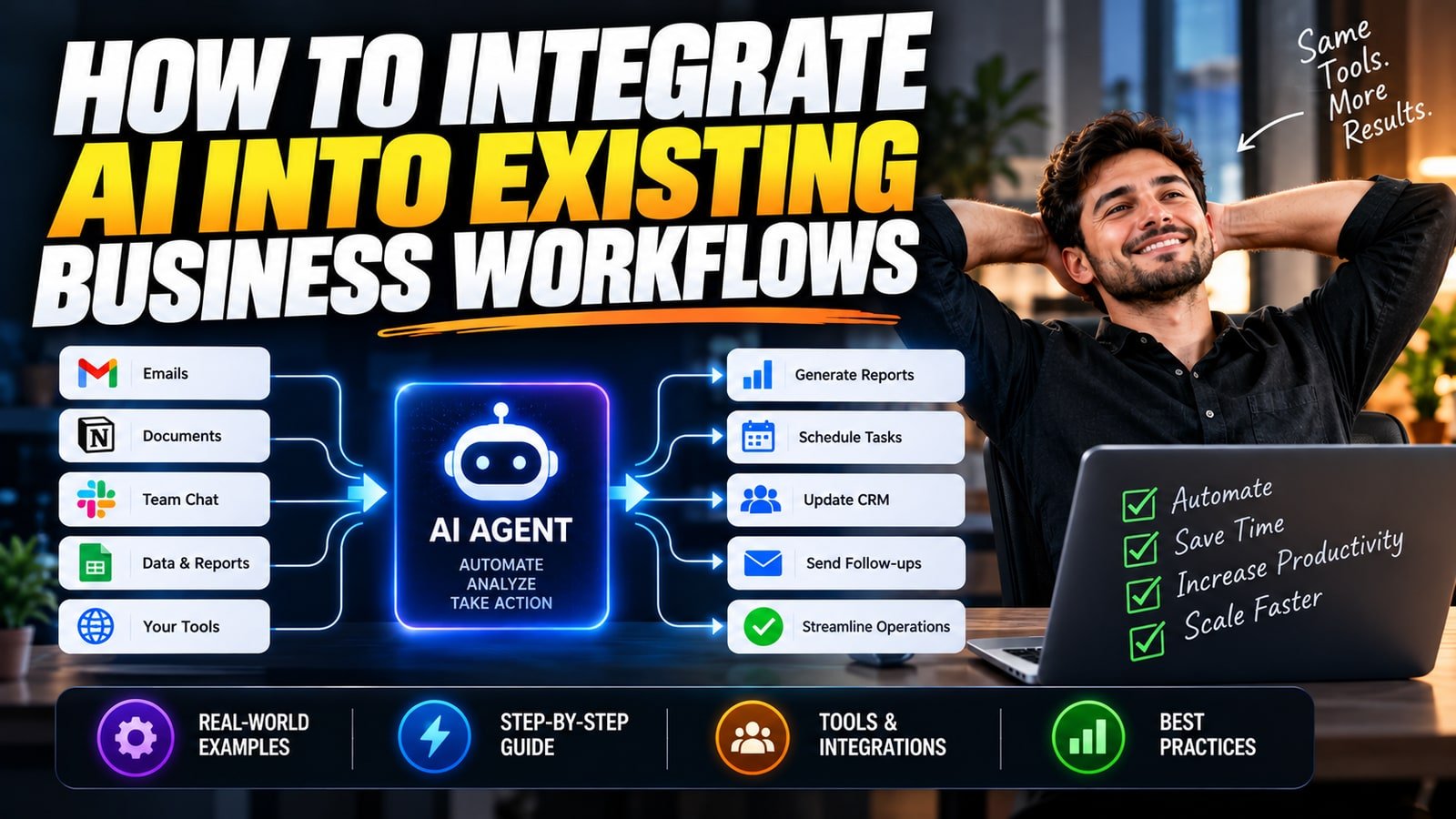
Integrating AI into an existing business workflow is a different job from building one around AI, and most published advice is about the second. A process that is already running has people who depend on it, records that must stay correct, and a cost to being down that a greenfield project does not have. The approach that survives contact with that reality is narrow: insert AI at one step rather than redesigning the flow, give it the least authority that is useful, and let it earn more. This is how to sequence that.
Key takeaways
- Integrating AI into a process that already works is an insertion at one step, not a redesign — the accumulated adaptations in a working workflow are an asset a rebuild throws away.
- The right place is the step where a person reads unstructured information and makes a small judgment; the steps either side were automatable long before AI and usually already are.
- Grant authority in three levels — read-only, then draft with human approval, then unsupervised action — and move up on evidence rather than on a deadline.
- Most workflows should stop permanently at the draft level. Reviewing is far faster than producing, and that is a successful outcome rather than a half-measure.
- Run it alongside the existing process for enough volume to see the unusual cases, then read the disagreements individually — the ones where both answers are defensible reveal a rule that was never defined.
- Decide what happens when the AI is unsure before going live, route low-confidence cases to a named person with the context attached, and count escalations as an early warning signal.
- Keep the manual path genuinely usable for at least a quarter. Integrations break for reasons unrelated to the model, and cheap reverting is what makes going live a low-stakes decision.
- Leave alone: irreversible actions, steps running a few times a month, pain caused by a broken process, and decisions nobody can state the rule for.
Integration is an insertion, not a rebuild
The common failure is scope. Somebody decides the intake process should be AI-powered, and what was going to be a two-week change becomes a redesign of how leads are handled — new fields, new stages, new tool, and a team being retrained on all of it while still doing their jobs. The AI part works fine. The project stalls on everything around it.
A working process is a liability as well as an asset. Every part of it that currently functions is something you can break, and the people doing it have adapted around its quirks in ways nobody has written down. That accumulated adaptation is worth more than it looks, and a rebuild discards it.
So the useful frame is surgical. You are not improving the workflow. You are identifying the single step that costs the most human attention, putting something there, and leaving every other step exactly as it is — same tools, same stages, same handoffs. If the integration works you can do it again on the next step; if it does not, you have reverted one thing rather than unwound a project.
This sounds modest and it is the reason it ships. A change confined to one step can be explained in a sentence, tested against yesterday's work, and turned off on a bad Monday without anyone needing a meeting about it.
Find the step where someone reads something and decides
In almost every business workflow there is one point where a person looks at unstructured information and makes a small judgment. Reading an inbound email and deciding which team it belongs to. Scanning an invoice and deciding whether it matches the purchase order. Reading a support ticket and deciding how urgent it is. Looking at a form submission and deciding whether it is a real inquiry or spam.
That is where current AI is genuinely strong, and it is usually the step that nobody automated before, because conventional rules could not handle the variety. The steps on either side — moving the data, updating the record, sending the notification — were automatable a decade ago and probably already are.
This is why asking "how do we use AI here?" produces worse answers than asking "where does someone read something and decide?" The first invites a tool hunt. The second points at a specific step in a specific process, which is the only thing you can actually build against.
Be suspicious if the answer is that nobody reads anything and decides. That usually means the judgment is happening somewhere you are not looking — in somebody's head before they even open the system, or in a message thread that never touches the workflow. Finding it is part of the work, and it is often the most valuable thing the exercise produces.
- Walk the process as it actually runs, not as the documentation says it runs.
- Mark every point where a human reads free text, an image, or a recording.
- For each, ask how long it takes and how often it is done.
- The step with the most occurrences per week is the candidate — not the one that feels hardest.
This is the ground we cover in an AI consultation — a diagnostic session that ends with a costed plan rather than a proposal.
Three levels of authority, earned in order
Once you know the step, the question is how much the AI is allowed to do there. Treat this as three levels, each of which has to earn its way into the next rather than being granted at the start.
The first is read-only. The AI looks at the same input the person does and records what it would have concluded, without affecting anything. Nobody's work changes. What you get is a few weeks of paired data showing where it agrees with your team and where it does not, which is the only honest basis for deciding whether to go further. This level is frequently skipped and it is the cheapest information you will ever buy.
The second is draft. The AI does the work and a person approves it before it takes effect. The classification is suggested and confirmed with a click; the reply is written and edited before sending. The time saved is real even though a human is still in the loop, because reviewing is much faster than producing. Most workflows should stop here permanently, and that is a success rather than a half-measure.
The third is act. The AI completes the step unsupervised within defined limits, with a person involved only on exceptions. This should be reserved for cases where level one proved high agreement, level two ran long enough to be boring, and the cost of a mistake is low or quickly reversible. Going straight to this level is the single most common way an integration damages trust it then cannot rebuild.
- Level 1 — read-only: it records what it would have done. Nothing changes.
- Level 2 — draft: it does the work, a person approves before it takes effect.
- Level 3 — act: it completes the step, a person handles exceptions only.
- Move up a level on evidence from the level below, never on a deadline.
Run it beside the process, not instead of it
During level one, the existing process continues untouched and the AI runs in parallel on the same inputs. The comparison between the two is the deliverable, not the AI's output.
How long depends on volume rather than the calendar. What you need is enough cases to have seen the unusual ones, which for a step running fifty times a day is a couple of weeks and for one running five times a week is a couple of months. Picking a duration before counting the volume is how teams end up confident on the basis of nine examples.
The disagreements matter more than the agreement rate, and they need reading individually rather than summarizing into a percentage. Some will be the AI being wrong. Some will be the AI being right and the person having been wrong, which is uncomfortable and genuinely useful. A meaningful share will be cases where both are defensible, which tells you the rule was never clearly defined — and that is a management problem the integration has surfaced rather than caused.
That third category is the most valuable output of the whole exercise and the reason not to skip this stage. You cannot automate a decision that two competent people would make differently, and you usually do not know that is true until something mechanical tries to do it.
Decide in advance what happens when it is unsure
Every integration needs an answer to one question before it goes live: what does this do when it does not know? A system with no answer will do the most damaging thing available, which is to proceed confidently.
The mechanics are not complicated. The step produces a confidence signal, cases below a threshold route to a person, and that person is named rather than a queue nobody owns. What matters is that the uncertain path is built at the same time as the main one, not added after the first incident.
Two details are worth getting right. The escalated case should carry what the AI saw and what it was unsure about, so the person is not starting from scratch — an escalation that arrives as a bare record is worse than no automation, because somebody now has to reconstruct context the system already had. And escalations should be counted. A rate that climbs is the earliest signal that something upstream has changed.
Set the threshold conservatively at first and tighten it with evidence. Over-escalating costs a little time; under-escalating puts wrong work into a live process and the cost of that is not symmetrical.
Keep the manual path working
The old way of doing the step should stay available and functional after the new one goes live. Not documented as a theoretical fallback — actually usable, by someone who has done it recently.
Integrations fail in ways that have nothing to do with the AI. A vendor changes an API. A credential expires. An upstream system starts sending a field in a different format. In each case the question is not whether the model was good but whether the business can still process the work that afternoon.
In practice this means not deleting the old form, not removing the manual override, and not letting the only person who knew how to do it by hand forget. It is tempting to clear these away as evidence of progress, and that temptation should be resisted for at least a quarter after the step is running unsupervised.
It also changes the character of the decision to go live. If reverting is a five-minute toggle, the choice to turn something on is cheap and you will experiment usefully. If reverting means a week of catch-up, every decision becomes heavy and the integration will stall in testing rather than ship.
The part nobody plans: the person whose job it touches
A step being automated is currently somebody's work, and that person is both the main source of the knowledge needed to build it and the one with the most reason to be wary. How that is handled determines more outcomes than the technical design.
The practical move is to make them the reviewer rather than the subject. During level one they are the one reading the disagreements and saying which is right, which is the most informed role available and makes the system better. Teams that do this get accurate edge cases early; teams that build it quietly and announce it discover the edge cases in production, because nobody was motivated to mention them.
Be straight about what happens to the time. If the honest answer is that the work moves to higher-value tasks, say which ones. If the honest answer is that headcount will not grow as the business does, say that instead. The version that destroys trust is the vague reassurance that turns out not to be true, and once it does, the next integration gets no cooperation from anybody.
It is also worth saying plainly that the people doing a process daily know things about it that are in no document. An integration built without them is usually built against a version of the workflow that has not existed for two years.
Where not to put AI in a working process
Some steps in an existing workflow should be left alone, and knowing which is part of doing this well.
Anything irreversible and consequential — issuing a refund, sending a contract, deleting records, making a payment — should keep a human release even when the AI prepares the work perfectly. The saving from removing that click is small and the cost of the rare bad case is not.
Low-frequency steps are the second. A judgment made four times a month does not produce enough examples to validate against, and the integration will cost more to build and maintain than the attention it returns. Volume is what makes this worth doing; without it, the arithmetic does not work however good the technology is.
Third, steps that are only painful because the process is wrong. If somebody spends an hour a week reconciling two systems that should not be separate, putting AI on the reconciliation makes a bad design permanent and harder to see. Fix the design. This is the one that most often gets automated anyway, because fixing it is somebody else's budget.
And finally, any step where the rule cannot be stated. If nobody can explain what makes the decision right, the integration has nothing to be measured against, and you will not be able to tell a good run from a bad one.
- Irreversible or high-consequence actions — keep the human release.
- Steps that run only a few times a month — not enough volume to validate or justify.
- Pain caused by a broken process — fix the process instead of automating around it.
- Decisions nobody can state the rule for — there is nothing to measure against.
The sequence, in order
None of the steps above are difficult individually. Doing them out of order is what makes integrations fail, and the most common inversion is granting authority before gathering evidence.
Walk the real process and find the judgment step. Build it read-only and run it alongside for enough volume to have seen the unusual cases. Read the disagreements one by one with the person who does the job today. Move to drafting with a human approving, and stay there until it is boring. Only then consider letting it act unsupervised, and only where a mistake is cheap and quickly undone — with the escalation path and the manual fallback both tested before that day, not after.
Then stop and leave it running for a while before doing the next one. The instinct after a success is to integrate three more steps at once, and that is how a working change becomes a program nobody can debug.
This assumes you have already chosen the workflow — how to pick which process to start with covers the scoring that comes before any of the above.
Related services
AI Workflow Automation
We architect and build intelligent workflow systems that connect your tools, execute decisions, and run processes around the clock — without any human input.
Explore automation infrastructureCRM Automation
We turn your CRM into an intelligent revenue engine — automated pipelines, smart follow-ups, AI scoring, and reporting that shows what to do next.
Explore crm intelligence