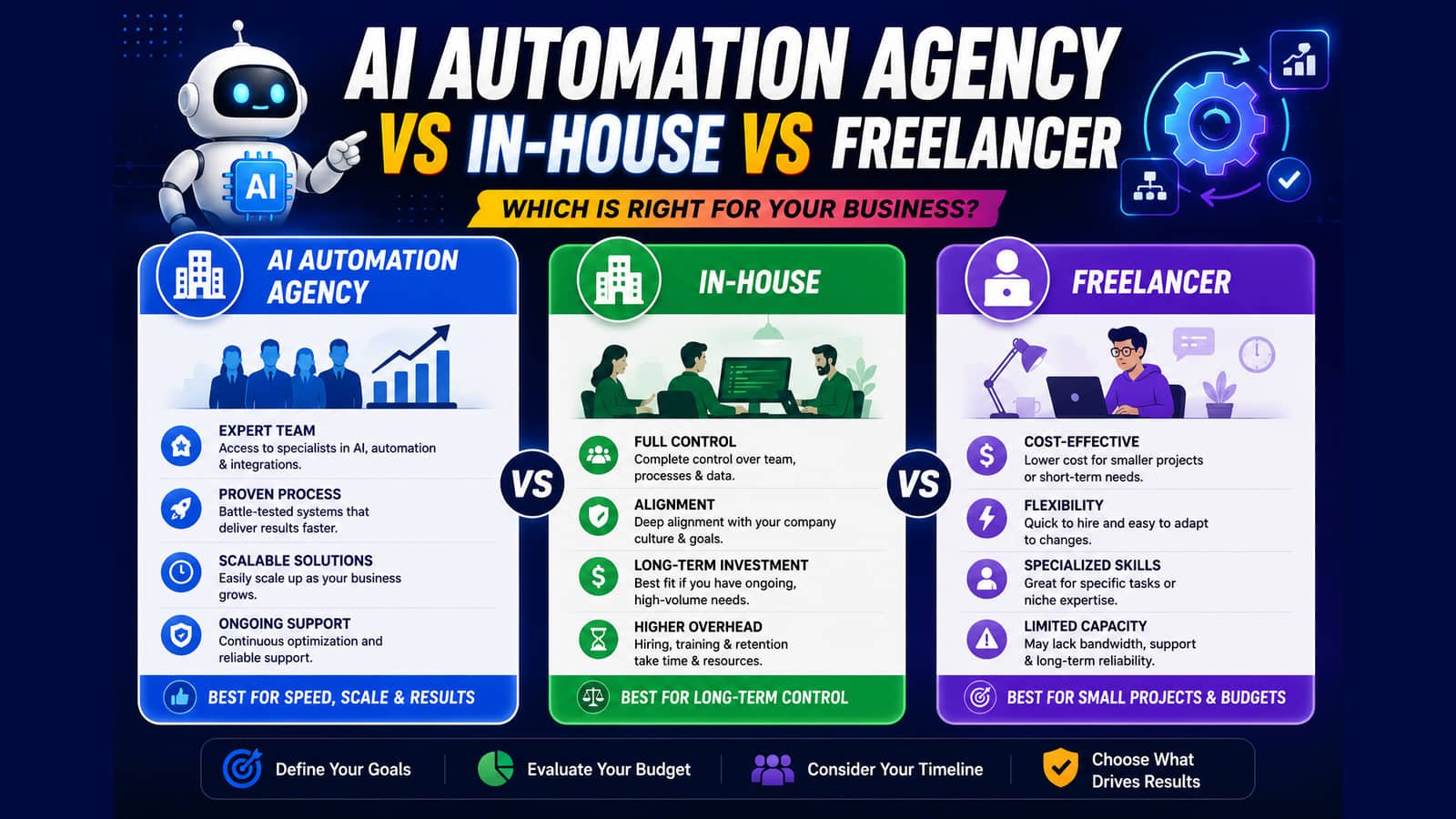
There are three ways to get automation built, and the price difference between them is larger than most people expect. A fully loaded in-house AI engineer costs $185,000 to $265,000 a year. A capable freelancer runs $40 to $100 an hour, or $200 to $1,500 for a single workflow. An agency build is typically $5,000 to $15,000 for the first system. Those numbers are not comparable on their own, because the three options are not buying you the same thing — and picking on price alone is the most common way this decision goes wrong.
Key takeaways
- An in-house AI engineer loads to $185,000-265,000 a year, plus months of recruiting and ramp before anything ships.
- Freelancers are $40-100/hr mid-level, $200-1,500 per workflow — right when the job is already well defined.
- Agencies run $5,000-15,000 per build; you are paying for scoping, monitoring and handover, not just the code.
- Projects fail from choosing the wrong process, not from bad code — which is what scoping buys you.
- Most businesses should start external, learn what they actually need, then hire in-house once volume justifies it.
In-house: what it really costs
The salary is the smallest part of the bill. Base pay for an AI automation engineer in the US averages around $107,000 to $142,000 depending on the source, but the loaded cost — employer taxes, benefits, recruiting fees, tooling and model API budget — lands between $185,000 and $265,000 a year. For senior talent it goes considerably higher.
Then there is time. Recruiting a specialist in this market takes months, and a new hire needs a ramp before they ship anything meaningful. If your goal is one working automation this quarter, hiring is not a route to it.
The argument for in-house is not cost and never has been. It is control and permanence: if automation is going to be a core, permanently evolving part of how your business runs, eventually you want that capability inside the building.
Freelancer: cheapest per hour, most variable
Freelance automation specialists run $40 to $100 an hour for solid mid-level work, with senior specialists at $125 to $250 and up. Project pricing is often $200 to $1,500 for a single workflow build, and $1,000 to $3,000 a month for ongoing help.
That is genuinely cheap, and for a well-defined, self-contained job it is often the right answer. If you know exactly what you want built, the process rules are settled, and it touches one or two systems — hire a freelancer.
The risks are concentrated in three places, and they are worth naming plainly.
- Single point of failure — if they take another contract or go quiet, you have no continuity and often no documentation.
- Scope definition falls to you. A freelancer builds what you specify; deciding what should be specified is the hard part, and it is not usually included.
- Ownership drift — work built in their accounts, on their tooling, with prompts you never see.
- No monitoring. Freelance builds tend to be delivered and left, so failures surface when a customer complains.
This is the kind of system we build as an AI automation agency for US businesses — scoped to the process, not sold as a seat licence.
Agency: more expensive per hour, priced for the outcome
An agency build typically runs $5,000 to $15,000 for a first system, with ongoing support at a median of $2,800 to $7,000 a month for small and mid-market businesses. Per hour that is more than a freelancer. Per outcome it often is not, because the scoping, testing, monitoring and handover are included rather than assumed.
What you are actually buying is the part before the build: someone deciding what is worth automating, in what order, and what to leave alone. Businesses rarely fail at automation because the code was wrong. They fail because the wrong process was chosen, or because nobody agreed what success meant.
The honest downside is that agencies are more expensive than they look if your need is genuinely small. A single, simple, well-specified workflow does not need an agency, and any agency telling you otherwise is selling.
The comparison that actually matters
Cost per hour is the wrong axis. These are the dimensions that determine whether the project succeeds.
- Time to first working system — freelancer fastest for a defined job, agency fast for an undefined one, in-house slowest by months.
- Who decides what to build — you (freelancer), them with you (agency), them once ramped (in-house).
- Continuity if one person leaves — none, agency-level, team-level.
- Monitoring and maintenance — usually absent, usually included, fully yours.
- Cost at year three — freelancer cheapest if needs stay small, agency flat, in-house cheapest if needs grow large.
Which one is right for you
The decision is mostly determined by two things: how well-defined the work is, and how central automation will be to your business in three years.
Choose a freelancer when the process rules are already agreed, the job touches one or two systems, and you can specify it in a paragraph. Choose an agency when you know something is wasting time but not what to fix, when several systems must connect, or when nobody internally will own it after go-live. Choose in-house when automation is becoming core infrastructure, when the work will never stop evolving, and when the volume justifies a salary — which for most businesses is later than they think.
The sequence most businesses should actually use
This is rarely a permanent choice, and treating it as one is the mistake. The pattern that works looks like this.
Start with an agency or a scoped diagnostic to work out what is worth building and to get the first system live, so you have a proven return rather than a theory. Use that first build to learn what your real needs are — they are almost never what you assumed. Then, if automation has become central and the volume justifies it, hire in-house and have the agency hand over documentation and accounts.
Hiring first inverts this. You commit $200,000 a year to a capability before you know which processes are worth automating, and your new hire spends their first quarter doing the diagnostic work you could have bought for a fraction of it.
The hybrid nobody mentions
The most common mature setup is not one of the three. It is an internal owner — often someone already on the team, not a new hire — who understands the systems and handles day-to-day changes, with an agency on a light retainer for the harder builds and the things that break.
That works because the two failure modes cancel out. The internal person provides continuity and context an external party never fully has; the agency provides depth and monitoring that one person cannot cover alone. It is also considerably cheaper than a full-time specialist.
This compares three ways to get systems built. If you are one step earlier and weighing advisory work instead, the piece comparing an consultation against an in-house hire covers that decision.
Related services
AI Workflow Automation
We architect and build intelligent workflow systems that connect your tools, execute decisions, and run processes around the clock — without any human input.
Explore automation infrastructureCRM Automation
We turn your CRM into an intelligent revenue engine — automated pipelines, smart follow-ups, AI scoring, and reporting that shows what to do next.
Explore crm intelligence