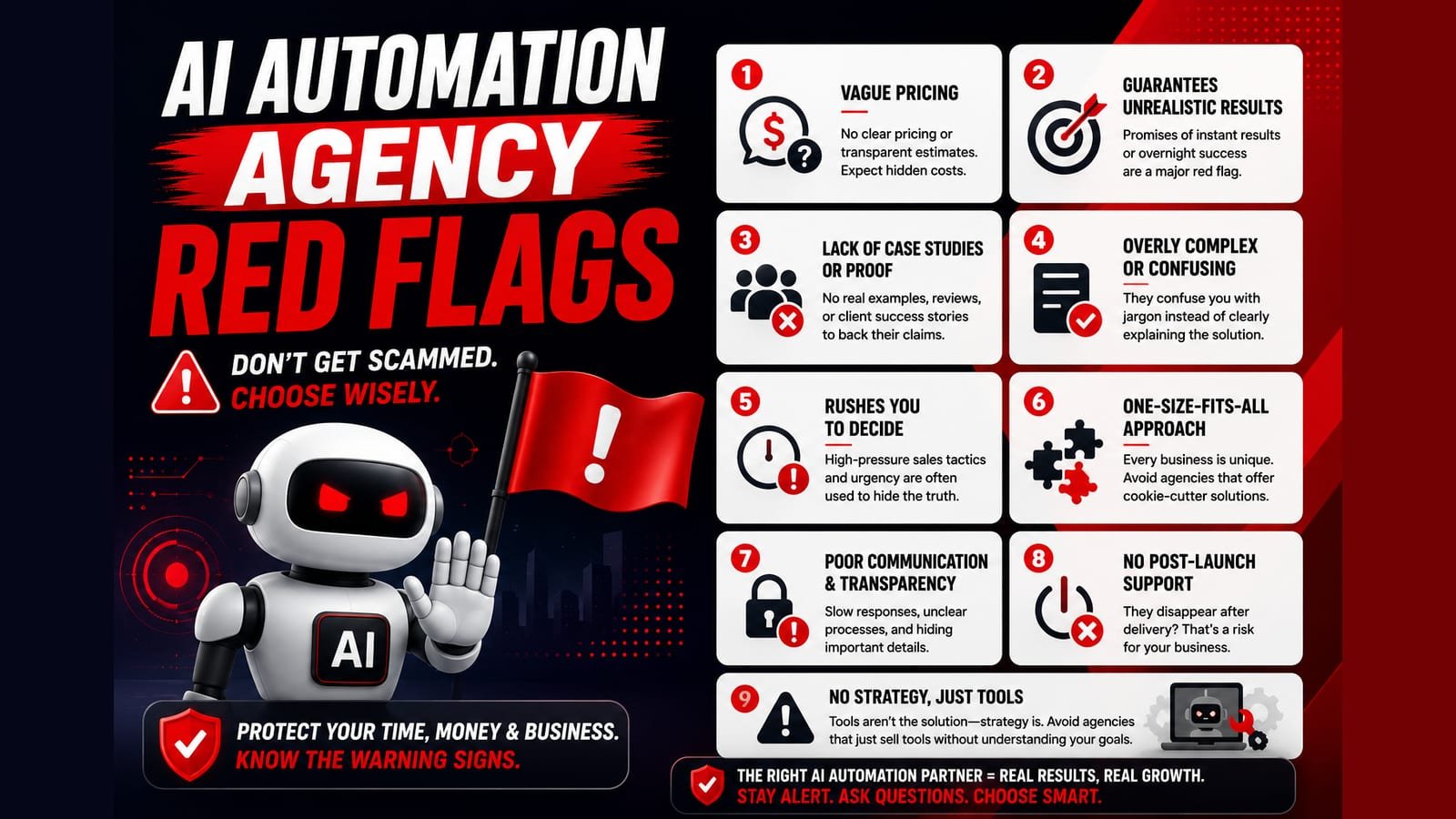
Most advice about vetting an agency stops at the sales call, which is the least dangerous stage because it is the one everybody is paying attention to. The expensive problems show up later: in clauses nobody read closely, and in the first month of work when a pattern becomes visible but nobody wants to be the one to raise it. These are the signs worth knowing at all three stages.
Key takeaways
- The pitch is the least dangerous stage — most engagements go wrong in the contract or the first month.
- Check for IP assignment clauses that transfer your configurations and workflows back to the vendor.
- 45% of enterprises say lock-in has already stopped them adopting better tools; test whether you could leave, not whether you want to.
- Name the export format (CSV, JSON, XML) and a timeframe — 30 days after termination — in the contract.
- How an agency communicates bad news in month one predicts how the engagement ends better than any reference.
In the pitch
Three signals here are worth acting on. They are the shortest section of this post deliberately — the pitch is where evaluation advice usually stops, and it is not where most engagements go wrong.
- Demo-only proof. They can show the technology working but cannot name a system still running in a client's business six months on.
- A fixed quote before anyone has looked at your systems. That number is a guess, and guesses are revised upward once discovery reveals the data work.
- Over-scoping. A six-figure programme proposed for a problem you described in one sentence usually means the scope was built to fit a target, not a need.
In the contract: who ends up owning your work
This is where the costly surprises live, because contract language is read once and its consequences arrive a year later.
The clause to look for specifically: many vendor agreements include IP assignment terms that transfer customer-created work back to the vendor, granting them rights over the customisations, integrations and workflows built during the engagement. You can end up not owning the configuration of your own system.
There is a legitimate nuance. An agency's underlying methods, pre-existing components and internal tooling remain theirs — that is reasonable and you should be suspicious of anyone signing all of it away. What must be yours is the specific implementation: your configured workflows, the prompts written for your processes, your data, and the documentation.
This is the kind of system we build as an AI automation agency for US businesses — scoped to the process, not sold as a seat licence.
In the contract: how hard is it to leave
Lock-in is rarely a single clause. It accumulates across five layers — the model, the orchestration, the data, the governance evidence, and the organisational knowledge — until leaving means rebuilding all of it. In a 2026 enterprise survey, 45% said vendor lock-in had already prevented them adopting better tools, and 67% were actively trying to avoid depending on a single AI provider.
The test is not whether you intend to leave. It is whether you could.
- Data export only via a paid professional services engagement, rather than a button you can press.
- Export in a proprietary format that needs transformation before another system can read it. Insist on CSV, JSON or XML, named in the contract.
- No stated timeframe for handing your data back. Thirty days after termination is a reasonable ceiling; specify it.
- Per-seat licensing that reprices as you grow, so success with the system becomes progressively expensive.
- Sub-processor expansion without your consent — your data moving to third parties you never approved.
In the first 30 days
Once work starts, the signals change character. They are behavioural rather than contractual, and they are visible early if you know what you are looking at.
The clearest one is silent scope drift. Scope creep almost never arrives as a formal change — it accumulates out of small assumptions that felt too obvious to state at the time. Extra steps and nice-to-have features appear in the work without anyone naming the effect on budget or timeline. By the time it is visible in the schedule, it has already consumed the buffer.
The second is approval ambiguity. If nobody established who holds the pen, work gets approved by one person on Tuesday and reopened by another on Friday. That is as much your failure as theirs, and it is fixable in an hour if you catch it in week one.
The third is the quiet week. An agency that goes quiet when something slips, rather than telling you early, is showing you how the next twelve months will go. How a partner communicates bad news in month one is the single most reliable predictor of how the engagement ends.
The one nobody notices until it costs money
Ask what happens if the automation fails at 7am on a Monday — who finds out, and how. If the answer is that you will notice when something looks wrong, the system has no monitoring.
This matters more for automation than for most software. A broken manual process is obvious because a person is standing in front of it. A broken automated process is silent: leads stop being routed, invoices stop matching, and everything looks fine on the surface until someone eventually asks why the numbers moved. Silent failure running for three weeks is far more expensive than an outage you can see.
What to do when you spot one
Most of these are recoverable if raised early, and almost none are recoverable if left. The cheapest hour anyone spends on an engagement is the one spent clarifying something the week it appears.
Raise it in writing, not on a call — not to build a case, but because the act of writing it down forces the ambiguity into the open. Ask for the specific change you want: the scope restated, the export clause added, the monitoring defined. A good agency will treat that as normal, because they have had the conversation before. The response tells you as much as the original problem did.
The ones that mean walk away
Three are not negotiable, because each one means you would be building a dependency you cannot exit.
- Systems only they can log into, described as managed for you. Your operations would depend on an account you cannot reach.
- No export path for your data, or export priced as a separate engagement.
- Refusal to answer what happens if the relationship ends. Vagueness there is not caution; it is the answer.
This covers what to watch for at every stage, including after you have signed. For the evaluation itself, the seven checks to run before you hire is the companion piece.
Related services
AI Workflow Automation
We architect and build intelligent workflow systems that connect your tools, execute decisions, and run processes around the clock — without any human input.
Explore automation infrastructureCRM Automation
We turn your CRM into an intelligent revenue engine — automated pipelines, smart follow-ups, AI scoring, and reporting that shows what to do next.
Explore crm intelligence