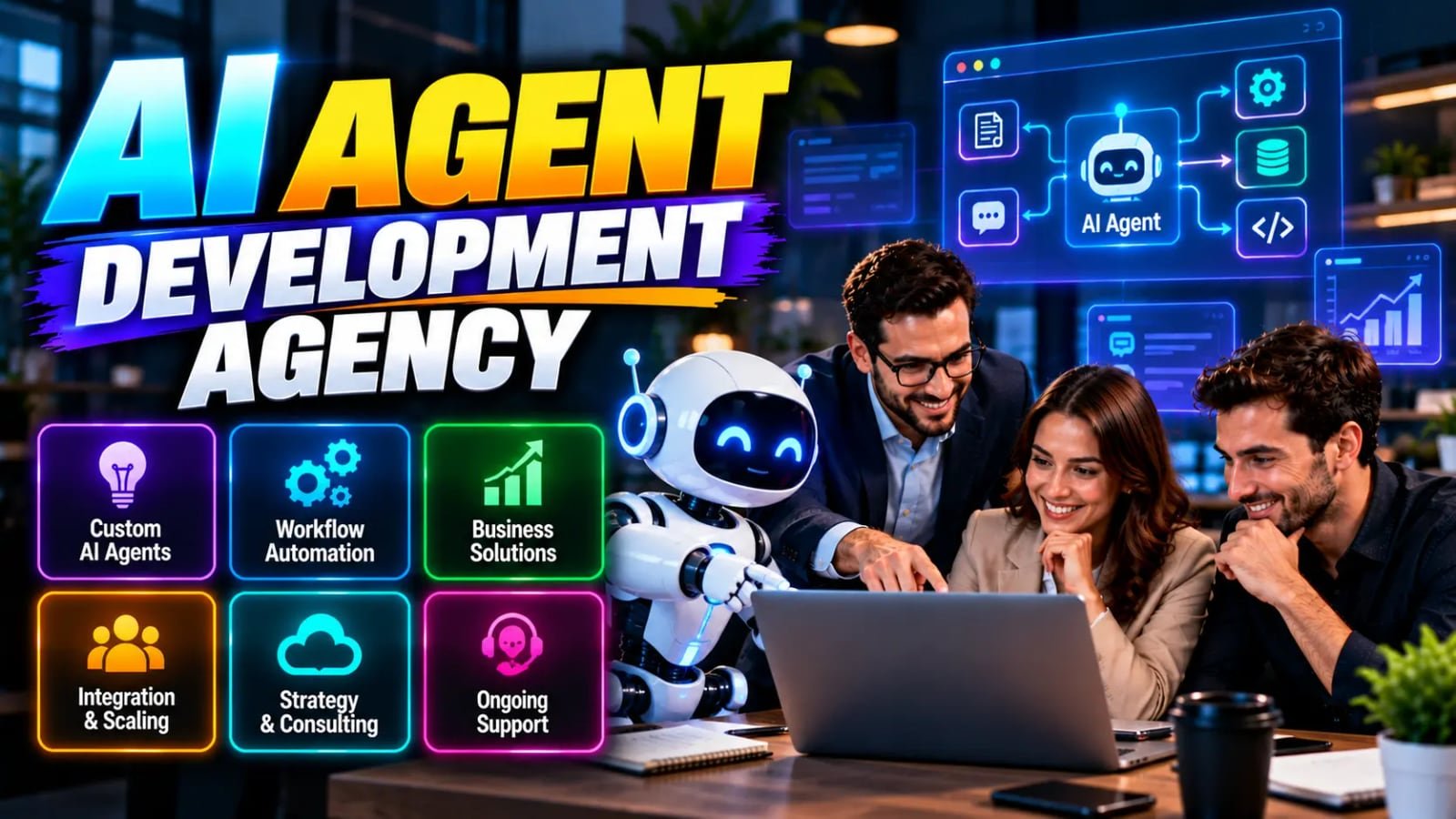
An AI agent development agency designs and builds AI agents for businesses: software that reads unstructured input like emails and documents, decides what to do, takes action inside the business's own tools, checks its work, and hands off to a person when it is unsure. Hiring one well depends on three things — knowing whether you need an agent at all or just an automation, knowing what a finished engagement should include, and knowing how a good agency proves an agent works before it touches live customers or money. This guide covers each, along with the red flags worth walking away from.
Key takeaways
- An AI agent agency builds software that reads unstructured input, decides, acts in your tools, checks itself and escalates when unsure.
- If a process has no "read it and decide" step, a plain automation is cheaper and more predictable than an agent.
- Expect a scope document, narrow permissions, approval gates, an evaluation set from your own data, monitoring, and ownership of everything built.
- A good agency proves an agent on real past cases and in shadow mode before reducing supervision.
- Walk away from do-everything agents, unapproved irreversible actions, sandbox-only demos and missing evaluation plans.
What an AI agent agency does
An AI agent agency is a services firm whose main product is agents. It scopes a job, connects an AI model to the systems that job touches — CRM, inbox, calendar, help desk, internal databases — builds the logic that lets the model decide what to do, and puts limits around it: what it may do alone, what needs a person's approval, and what it must never do.
The agent itself is software that keeps running after the agency has built it. That is the difference from a firm that uses AI to deliver a service, like a marketing agency writing content with AI tools. With an agent agency, what you buy is a working system inside your business, which raises the questions that matter most: who owns it, who watches it, and what happens when it gets something wrong.
A disclosure, since it bears on how you read the rest: Vibess builds AI agents for clients, so we are one of the firms this guide describes.
AI agent or plain automation? Settle this first
Not every job needs an agent, and the most useful thing an agency can do in the first conversation is tell you when yours does not. A plain automation — the kind built in Zapier, Make or n8n — follows the same steps every time: when a form is submitted, create a contact, send an email, notify the team. It is cheaper to build, cheaper to run, and completely predictable.
An agent earns its place where the input varies and a decision is needed. A customer email that could be a complaint, a reschedule, a billing question or a new inquiry. An invoice that arrives in a dozen formats. A lead whose details need looking up before anyone can say whether they qualify. Those steps need something that can read and judge, and that is what a model provides.
A useful test: if you can draw the whole process as a flowchart with no box that says "read it and decide," build an automation. If there is one such box, the usual right answer is an automation with a single agent step at that point — not an agent running the whole process. Agencies that propose an agent for everything are often selling the more expensive build.
This is how we approach custom AI agents — one job per agent, real tools, and a person on anything irreversible.
What AI agent agencies actually build
Most production agents in small and mid-sized businesses do one narrow job that used to take a person's attention many times a day. Typical examples:
- Inbox triage — reading incoming email, sorting it by intent, drafting replies for approval, and routing what it cannot handle.
- Document intake — pulling fields out of invoices, applications or forms that arrive in inconsistent formats, then checking them against your records.
- Lead research and qualification — looking up a new lead, scoring it against your criteria, and updating the CRM before a salesperson calls.
- Support resolution — answering routine tickets from your own knowledge base, with anything unclear escalated to a person.
- Scheduling — handling booking and rescheduling requests across calendars and confirming by email or text.
- Internal lookup — answering staff questions from your own documents and systems, with sources shown.
What a finished agent engagement should leave you with
An agent is only as safe as the limits around it, so the deliverables matter as much as the demo. At the end of an engagement you should hold all of the following — and own the accounts they live in.
On the technical side, agencies connect agents to tools in several ways, including the Model Context Protocol (MCP), an open standard Anthropic introduced in November 2024 for connecting AI assistants to the systems where data lives. The connection method matters less than what it is allowed to do. Ask what permissions the agent's credentials carry, and insist they are the narrowest that let it do its job.
- A scope document: the one job, what the agent receives, what "done" means, and a list of things it must never do alone.
- Tool connections under the agent's own credentials, with the minimum permissions needed.
- Approval gates on anything hard to undo — sending to customers, paying, deleting, publishing.
- An evaluation set built from your real past cases, and the results the agent scored on it.
- Logging and monitoring, so every action can be traced and failures are noticed.
- A named escalation path for cases the agent is unsure about.
- Documentation, plus ownership of the accounts, API keys, prompts and code.
How a good agency tests an agent before go-live
Demos prove very little. An agent shown working on three hand-picked examples has been tested on three hand-picked examples. A serious agency builds an evaluation set from your own history — a few dozen to a few hundred real past cases, including the awkward ones — and measures how the agent does on all of them before it goes anywhere near live work.
Then comes shadow mode. The agent runs alongside the person who does the job today, producing its answer without acting on it, and the two are compared. Supervision is reduced only once the agent's output holds up, and usually in stages: drafts for approval first, then low-risk actions alone, with irreversible ones staying behind a person.
Testing does not end at launch. The models agents run on are updated by their providers, and a change that improves one thing can quietly break another. Ask how the agency re-runs its evaluation when the underlying model changes, and what alerts tell someone the agent's behavior has drifted.
Questions to ask before you hire an AI agent agency
These separate firms that have shipped agents to production from firms that have built demos. Listen for specific, unhesitating answers.
- Would you recommend an agent for this at all, or a plain automation?
- What exactly will the agent be allowed to do on its own, and what needs approval?
- How will you test it on our real past cases before it goes live?
- What happens when it is unsure — who gets the case, and how quickly?
- What permissions will its credentials have in each of our systems?
- How will we know if its behavior changes after a model update?
- Who owns the accounts, keys, prompts and code when you are finished?
- What does it cost to run each month, and which of those costs do we pay directly?
How engagements are structured, and what drives the cost
Most agent work follows a similar shape: a scoping phase to define the job and the limits, a build-and-test phase for each agent, and an ongoing arrangement for monitoring and changes. Some firms price per agent, some per project, and some combine a build fee with a monthly fee for upkeep. On top of that come usage costs — the AI model calls the agent makes — which are often billed by the model provider directly to you, and which grow with volume.
What drives the price is mostly the job, not the technology. The number of systems the agent must connect to, how varied its inputs are, how much harm a mistake could do and therefore how many approval steps it needs, how accessible your data is, and any compliance requirements all move the effort. A quote you can trust names those factors; one that does not is a number without a scope.
Red flags when hiring an AI agent agency
Any one of these is reason to slow down. Two or more is reason to keep looking.
- A general-purpose agent that will "handle everything" — an agent with no defined job cannot be tested against one, so nobody can say whether it works.
- No human approval on irreversible actions like sending, paying or deleting.
- A demo that only ever runs in a sandbox, with no plan for real credentials and real data.
- No evaluation plan, or testing described only as "we'll try it and adjust."
- Accounts, keys or prompts held in the agency's name with no handover.
- No answer to what happens when the underlying model changes.
If the terms are still blurring together, we cover how an AI agency differs from an AI agent — and the other kinds of AI agency — separately.
Related services
Custom AI Agents
We build AI agents scoped to one job in your operation — reading unstructured input, calling the systems you already run, checking their own output, and handing back to a person when confidence is low.
Explore autonomous systemsAI Workflow Automation
We architect and build intelligent workflow systems that connect your tools, execute decisions, and run processes around the clock — without any human input.
Explore automation infrastructure