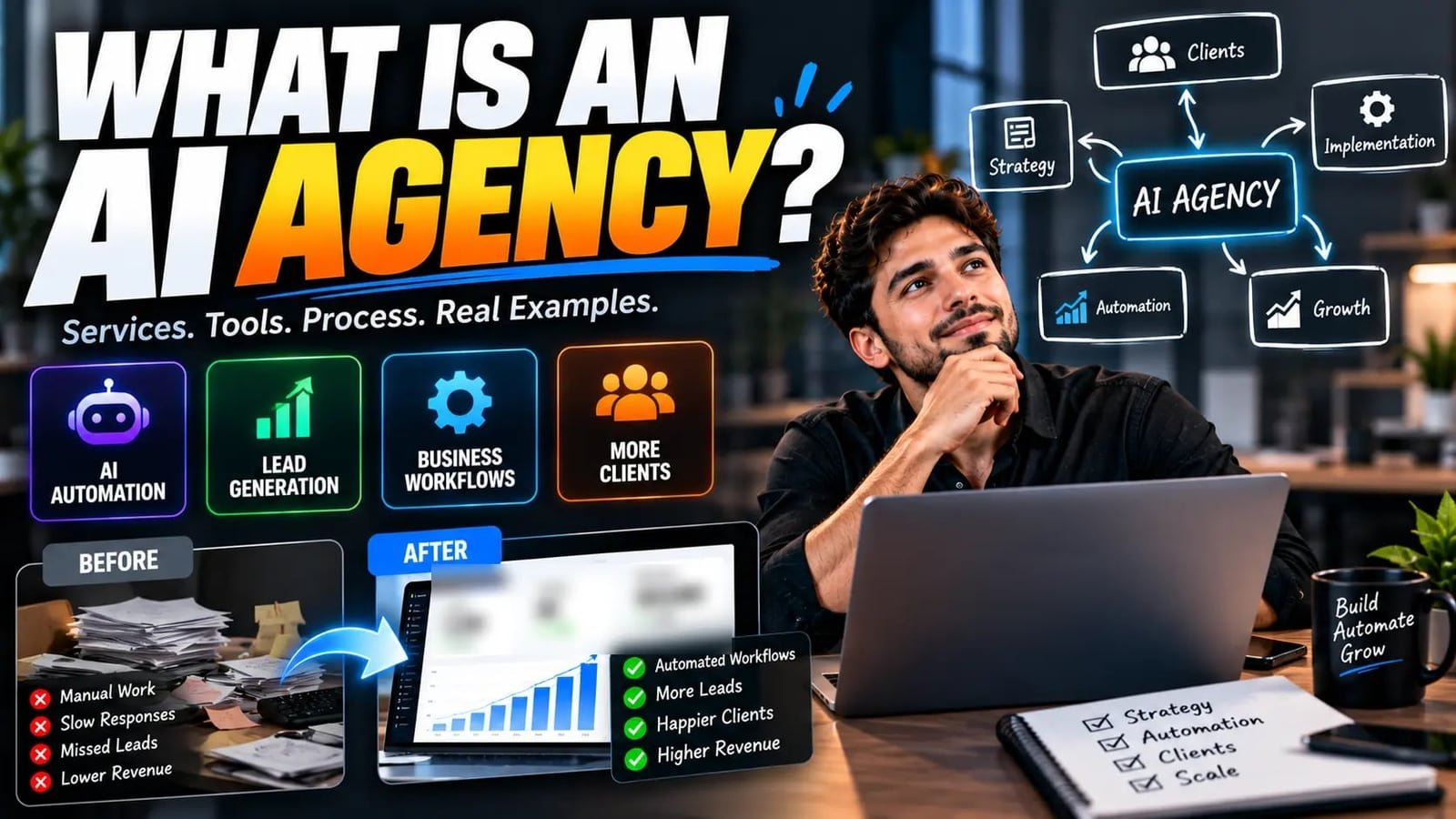
An AI agency is a service firm that businesses hire to put artificial intelligence to work — producing their marketing, building AI into their software, automating their operations, or advising them on where to start. The label covers all four, and they are different businesses with different deliverables, so the useful question is not whether to hire an AI agency but which kind. This guide sets out what each kind actually delivers, how each one charges, how to tell which one your problem calls for, and when you do not need one at all.
Key takeaways
- "AI agency" covers four different businesses: marketing agencies that use AI, development studios that build AI software, automation agencies that run AI inside your operations, and consultancies that advise.
- An AI agent is software; an AI agency is a firm. Some agencies build agents for their clients.
- Choose by problem: not enough demand points to marketing, too much manual work to automation, a product or custom tool to development, an unclear direction to a consultancy.
- Ask every firm what will exist in your business when the engagement ends — output, software, running systems or a plan — and who will own it.
- Check the AI features in tools you already pay for before hiring anyone; for a single-tool problem they are often enough.
What an AI agency is
Strip away the branding and an AI agency is a services business: people you pay to do work that involves AI, usually because you do not have the time or the skills to do it in-house. What separates it from a software company is that you are buying labor and judgment, not a product. You do not get a login to an AI agency; you get people working on your problem.
The term is new and loosely used. A marketing firm that adopted AI writing tools, a software studio that builds machine-learning features, a two-person shop wiring ChatGPT into a CRM, and a strategy consultancy that writes AI roadmaps all describe themselves as AI agencies. Nobody regulates the label and there is no certification behind it, so on its own it tells you almost nothing about what a given firm does.
That is why the kind matters more than the label. The four kinds below overlap at the edges, and some firms do two of them, but each has a recognizable core: a different deliverable, a different way of charging, and a different kind of client it suits.
One other meaning is worth setting aside. In policy and news coverage, "AI agency" sometimes refers to a government body that studies or regulates AI. That sense has nothing to do with hiring a firm and is not the subject here.
AI agency vs. AI agent
The two terms get confused constantly, partly because they sound alike and partly because "agentic AI" is among the most heavily marketed ideas in the industry. They are different things. An AI agent is software: a system that takes a goal, decides on steps, and acts inside other tools — reading an inbox, updating a CRM, booking a meeting — with some independence. An AI agency is a company.
The overlap is that some agencies build agents. When a firm says it deploys AI agents, it means it will design and run that kind of software for you. It does not mean the agency itself runs without people, and a firm that implies its work is done by agents rather than staff deserves a direct question about who is accountable when something breaks.
If what you were looking for is software you can sign up for, you want an AI tool or an AI agent. If you want someone to build, configure or run that software against your business, you want an agency — and then the question is which kind.
This is the kind of system we build as an AI automation agency for US businesses — scoped to the process, not sold as a seat licence.
1. AI marketing agencies
The largest group by number. These are marketing agencies — content, paid ads, SEO, social — that use AI tools to produce the work. Some were founded around AI; many are established agencies that added AI to their process and to their name.
What you get is marketing output: articles, ad creative and its variations, social posts, campaign reporting. The AI mostly lives inside the agency's own production process, which means you are buying results rather than a system. When the engagement ends the output stops, and in most cases nothing new is left running inside your business.
They usually charge a monthly retainer scoped by volume of output or by channels managed, the same way traditional agencies do. That fits ongoing work, and it is also a fair test of what the AI is doing for you. If AI made their production faster, ask whether you see that as more output, a lower price, or neither.
They suit a business whose bottleneck is demand: not enough leads, not enough content, not enough reach. They do not suit a business whose bottleneck is handling the demand it already has. That is an operations problem, and it belongs to a different kind of firm.
2. AI development agencies
These are software studios. They build things: a custom application with AI features, an AI capability inside a product you already sell, a model tuned on your own data, an internal tool that no off-the-shelf product can do. The people are engineers, and the work looks like software development because it is.
The deliverable is code — ideally in a repository you own — plus the infrastructure it runs on. That is a real asset and a real responsibility. Custom software has to be hosted, maintained and updated after the studio leaves, so someone on your side needs to own it technically, or you need a support agreement priced before the build begins.
They typically charge per project or by time: a fixed-scope build, or a team billed per sprint or per month. Projects are scoped up front, and the scoping work is often a paid engagement of its own.
They suit companies building a product, or with a need specific enough that no existing tool covers it. For a business that wants to automate its own operations they are usually more than the job requires. If the task is connecting a CRM to an inbox and a calendar, writing custom software for it is the long way around.
3. AI automation agencies
These firms automate a business's internal operations. Rather than writing new software, they connect the tools a business already runs — CRM, email, phone system, calendar, billing — and put automation and AI decision-making between them. Leads get answered and routed the moment they arrive, documents get read and filed, follow-ups go out without anyone having to remember to send them.
What you get is working systems inside your own business, plus the documentation to understand them. Unlike a marketing engagement, the result keeps running after the project ends. Unlike a development engagement, most of it is built on platforms you can see and configure, rather than in code only an engineer can change.
The common structure is a setup fee for the build and a monthly fee for monitoring and support. The monthly part exists for a practical reason: automations fail quietly. A broken integration does not announce itself; leads simply stop arriving where they should, and someone has to be watching for that.
They suit businesses whose problem is the volume of repetitive work: hours lost to data entry, leads that go cold waiting for a reply, manual follow-up, copying information from one system into another. A disclosure, since it matters when you weigh this guide: this is the kind of agency Vibess is.
4. AI consultancies
AI consultancies sell advice. They assess where AI would help, which processes and data are ready for it, what to buy versus build, and in what order — and they turn that into a plan. Some are large strategy firms with an AI practice; many are small specialists.
The deliverable is a document: a roadmap, often with vendor recommendations and a business case. That is worth paying for when the decision is genuinely unclear. The risk is a plan with nobody to carry it out. A consultancy that does not build hands you a list, and the work of turning it into something that runs is still ahead of you.
They charge per engagement or per day. Before you start, ask exactly what you will hold at the end and at what level of detail, and whether any recommended vendor pays the consultancy a referral fee or commission.
They suit organizations with several possible uses for AI, no in-house expertise, and enough at stake that choosing wrong is expensive. A small business with one obvious problem rarely needs a strategy phase. It needs that problem solved.
How to tell which kind of AI agency you need
Start from the problem, not the vendor. Once the problem is named precisely, the right kind of firm follows almost mechanically.
Two problems often look like one, and it is worth separating them before you pay anyone. A business that needs more leads sometimes has enough leads and loses them to slow follow-up. That is an operations problem, and a marketing agency will happily solve it by sending you more leads to lose. Look at what happens to the inquiries you already get before you spend money getting more.
Then test any firm against its own kind. Ask what will exist in your business when the engagement ends, who owns the accounts and the code, and what happens the first time something breaks. A marketing agency should answer the first with output, a developer with software, an automation agency with running systems, a consultancy with a plan. Any of them that cannot answer the second plainly is a risk, whatever kind it is.
A rough map from problem to firm:
- Not enough customers or attention — an AI marketing agency.
- Too much manual work handling the customers you already have — an AI automation agency.
- A product to build, or a tool no existing software provides — an AI development agency.
- Several possible directions and no basis for choosing — an AI consultancy, for a short engagement with a defined deliverable.
When you do not need an AI agency at all
More often than agencies admit. Much of the software a small business already pays for — CRMs, help desks, email platforms, accounting tools — now ships with AI features built in. If the problem is drafting replies, summarizing calls or scoring leads inside a single tool, turning on what you already have is the first step, and finding out whether it is enough costs nothing.
A single connection between two tools is not agency work either. Sending new form submissions into a spreadsheet is a no-code tool and an afternoon, or a freelancer for a few hours. Paying an agency's setup fee for it is out of proportion to the job.
And no agency of any kind can fix a process nobody owns. If no one in the business can say how a task is supposed to be done today, automating it or marketing around it only makes the confusion faster. Decide the process first; hire second.
An agency earns its fee when the work spans several systems, involves judgment rather than simple rules, and matters enough that it has to keep working after the person who set it up has moved on to something else.
If the automation kind is the fit, the next step is what an AI automation agency actually does — the work, phase by phase, from discovery to support.
Related services
AI Workflow Automation
We architect and build intelligent workflow systems that connect your tools, execute decisions, and run processes around the clock — without any human input.
Explore automation infrastructureCustom AI Agents
We build AI agents scoped to one job in your operation — reading unstructured input, calling the systems you already run, checking their own output, and handing back to a person when confidence is low.
Explore autonomous systems