
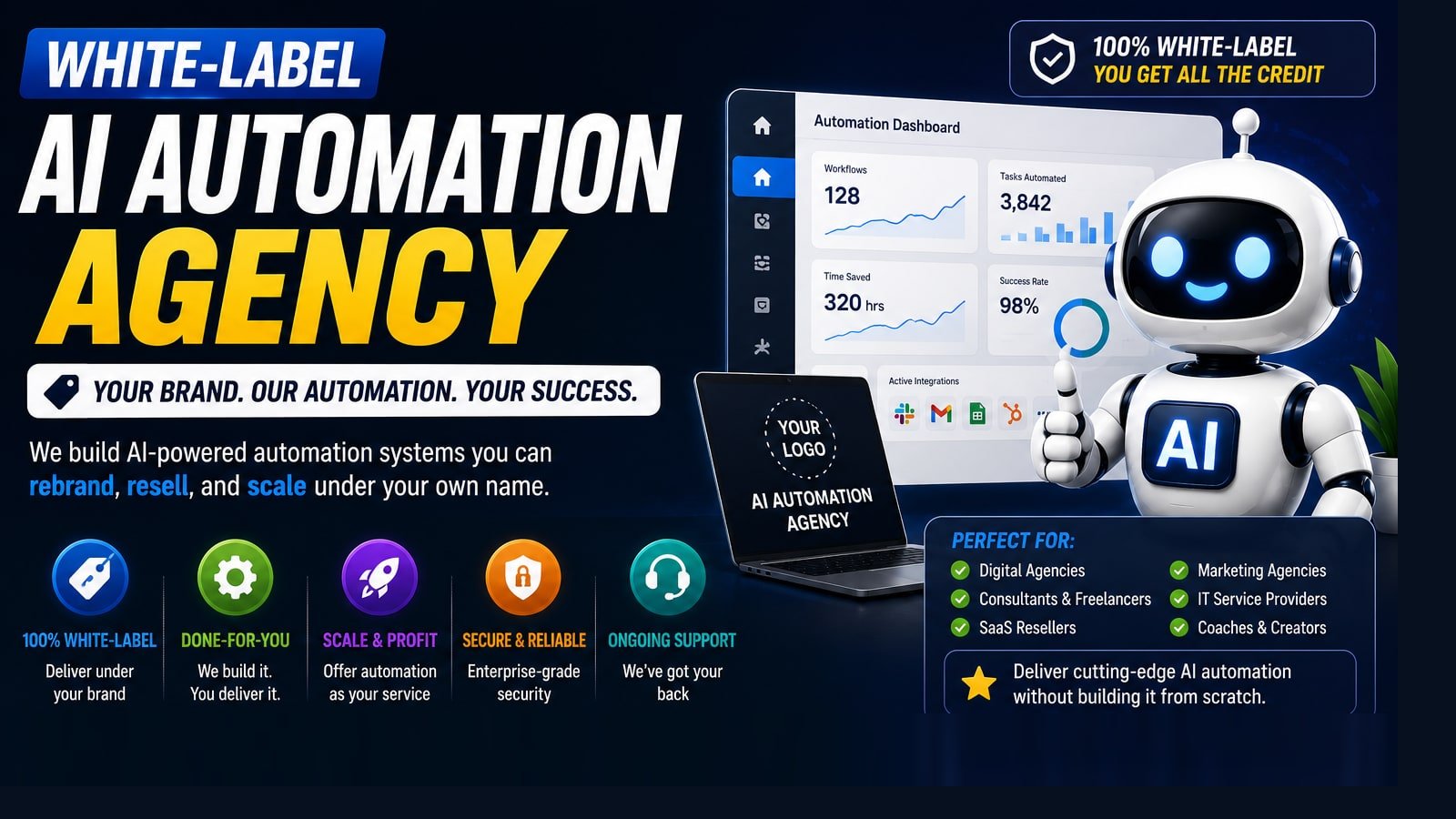
A marketing agency, a web design studio and a bookkeeping firm walk into the same problem: their clients keep asking for AI automation, and none of them want to hire an engineer to find out whether the demand is real. White-label is the obvious answer — someone else builds it, your name goes on it, you keep the relationship. That works, but not on the terms most people imagine when they first hear the phrase. This is what the arrangement actually looks like from both sides of it, including the parts that go wrong.
Key takeaways
- White-label means your client's only contract is with you — the partner's failure is commercially your failure, which is what the margin pays for.
- The three models are referral, managed white-label and full reseller; margin rises with how much delivery and support you take on.
- Scoping time and the rework loop are the costs that erode margin, and both sit on your side of the line unless the contract says otherwise.
- Settle support before signing: response times by severity, who monitors for failures, and whether the partner will join a client call under your brand.
- Accounts and credentials must sit under the client's billing with the partner added as a user — the reverse is the failure that only surfaces at exit.
- White-label until the repeat pattern is obvious, then hire against that pattern rather than against the ambition.
What white-label actually means in this market
White-label means the delivery partner is invisible to your client. You sell the work, you own the relationship, you send the invoice, and a partner does some or all of the building under your brand. Their name is not on the proposal, the calls, or the documentation.
That is a different arrangement from subcontracting, where your client knows a specialist is involved, and different again from referral, where you hand the client over and take a cut. All three get called white-label in sales conversations, which is where the first misunderstanding usually starts.
The distinction matters because it decides who carries the risk. Under a true white-label agreement, your client's only contract is with you. If the automation breaks on a Monday morning, they call you. Your partner's failure is legally and commercially your failure — that is what you are taking on in exchange for the margin and the brand.
Who this genuinely suits — and who it does not
White-label AI automation works best when you already have the relationships and lack only the delivery capacity. The clients trust you, the conversations are happening, and the bottleneck is that nobody in the building can wire an inbox to a CRM without breaking something.
It works badly when the demand is hypothetical. Reselling a capability you have never sold before means learning the sales motion and the delivery model at the same time, with a partner who cannot help you with the first one. Agencies in that position tend to sign a partnership, sell nothing for four months, and conclude that AI automation does not sell.
- Good fit: an existing client base already asking for automation by name.
- Good fit: you can scope a business process, even if you cannot build the system.
- Good fit: recurring client relationships, so support is a natural extension rather than a new product.
- Poor fit: no established client base — you are buying delivery for demand you do not have yet.
- Poor fit: one-off project work with no ongoing relationship to absorb maintenance.
- Poor fit: you want the revenue without ever touching the technical conversation. Somebody on your side has to understand what was built.
This is the kind of system we build as an AI automation agency for US businesses — scoped to the process, not sold as a seat licence.
The three models, and what each one costs you
Almost every partnership on offer is a version of one of these three. They differ in how much of the delivery you take on, which is also how the margin splits.
Referral is the simplest and the weakest. You introduce the client, the partner sells and delivers under their own name, and you take a one-off commission or a small share of the first year. No delivery risk, no support burden, and no asset — you have rented out your relationship once.
Managed white-label is the common middle. You sell and own the client, the partner builds and maintains under your brand, and you pay them a build fee plus a monthly for the running system. Your margin is the gap between what you charge and what they charge, and it shrinks by however much senior time your team spends on scoping and account management — which is more than most agencies budget for.
Full reseller means you take on first-line support and the client conversation entirely, and the partner is effectively your back-end engineering team at a wholesale rate. The margin is highest here and so is the obligation — you need at least one person who can triage a broken automation and tell the difference between a client error and a partner error.
Where the margin actually goes
The headline margin on a white-label deal is not the real one, because the costs that erode it sit on your side of the line and are easy to leave out of the model.
Scoping is the largest. Someone from your team has to sit in the discovery call, understand the client's process well enough to brief the partner, and then translate the partner's technical answer back into something the client can approve. That is senior time you are not billing.
Then there is the rework loop. A partner who has never met your client will build to the brief, and the brief will be wrong in some detail that only becomes visible once the system is running. Someone pays for the second pass. Whether that is you or them is a contract question, and if the contract is silent, it is you.
The practical guidance: price the first two or three engagements assuming you will spend far more of your own time than you expect, and do not quote a retainer until you have watched one system run for a full month. Agencies that get burned on white-label almost always got burned on a fixed price set before anyone understood the support load.
The support burden nobody prices in
An AI automation is not a website. It does not sit there once it is finished. It runs against live data, calls other companies' software that gets changed or retired without warning, and automates a process that will quietly drift as the client's business changes. Something will need attention every month.
The question to settle before you sign anything is what happens at 7am on a Monday when lead routing stops firing. Under white-label, your client calls you. If your partner's support commitment is a shared inbox with a next-business-day response, you have just promised something you cannot deliver, and the gap between those two promises is where the relationship dies.
Get the specifics in writing: response times by severity, who monitors the system and how failures are detected, what counts as maintenance versus new work, and whether the partner will join a client call under your brand when something is badly wrong. That last one is the tell. A partner who will not get on a call is selling you builds, not a partnership.
The contract terms that decide who keeps the client
The commercial terms are usually fine. The terms that cause real damage are the ones about ownership and access, and they only bite when the partnership ends.
The most common failure is silent: the partner builds inside their own platform accounts and their own login credentials because it is faster. Everything works until you part ways, and then the system your client's operations depend on lives somewhere neither of you can hand over.
- Accounts and access credentials created under the client's billing, with your partner added as a user — not the reverse.
- Documentation, prompts, workflow configurations and credentials delivered as a matter of course, not on request.
- Written IP assignment covering everything built for the client, with any pre-existing partner tooling named explicitly.
- A non-solicit that runs both ways and survives the agreement, so the partner cannot approach your client directly.
- A defined exit: what gets handed over, in what format, within how many days of termination.
- Clarity on where client data is processed and stored — you are the one who has to answer that question when a client's legal team asks.
How to vet a white-label partner
The vetting is stricter than hiring an agency for yourself, because you are inheriting their quality as your own reputation. Two questions do most of the work.
First: show me three systems you have shipped in the last six months that are still running. A demo proves the technology works, which was never the question. A system still running after six months proves it survived real data and a client who stopped paying attention to it. Ask what broke early and what it took to fix — a partner who has genuinely shipped will have specific, slightly awkward answers.
Second: what do you do when you disagree with my scope? A partner who says yes to everything will build the wrong thing correctly and hand you the bill. You want one who pushes back before the build, in front of you, and is willing to say which parts of a request they would not automate.
Beyond that: ask how many white-label partners they already carry and what their capacity looks like, because you are competing with those partners for the same engineers. Ask to speak to one of them. And run a small paid pilot before you put their work in front of your best client — the first project is the cheapest place to discover that communication is slow or documentation is imaginary.
When to build the capability instead
White-label is the right answer for testing demand and for absorbing overflow. It is a weaker answer once automation becomes a core part of what you sell.
The rough threshold is repetition. If you are delivering the same three or four system types over and over — lead routing, intake and qualification, reporting, a support triage layer — the marginal value of a partner falls with every repeat, and the margin you are handing over starts to look like a salary you could have hired against.
The sensible sequence is to white-label until the pattern is obvious, hire against the pattern rather than the ambition, and keep a partner for the work that falls outside it. Going straight to a hire before you know which systems actually sell is how agencies end up with an expensive engineer maintaining two automations.
Before you set a resale price you need the underlying numbers — what AI automation actually costs covers the 2026 ranges by pricing model.
Related services
AI Workflow Automation
We architect and build intelligent workflow systems that connect your tools, execute decisions, and run processes around the clock — without any human input.
Explore automation infrastructureCRM Automation
We turn your CRM into an intelligent revenue engine — automated pipelines, smart follow-ups, AI scoring, and reporting that shows what to do next.
Explore crm intelligence