
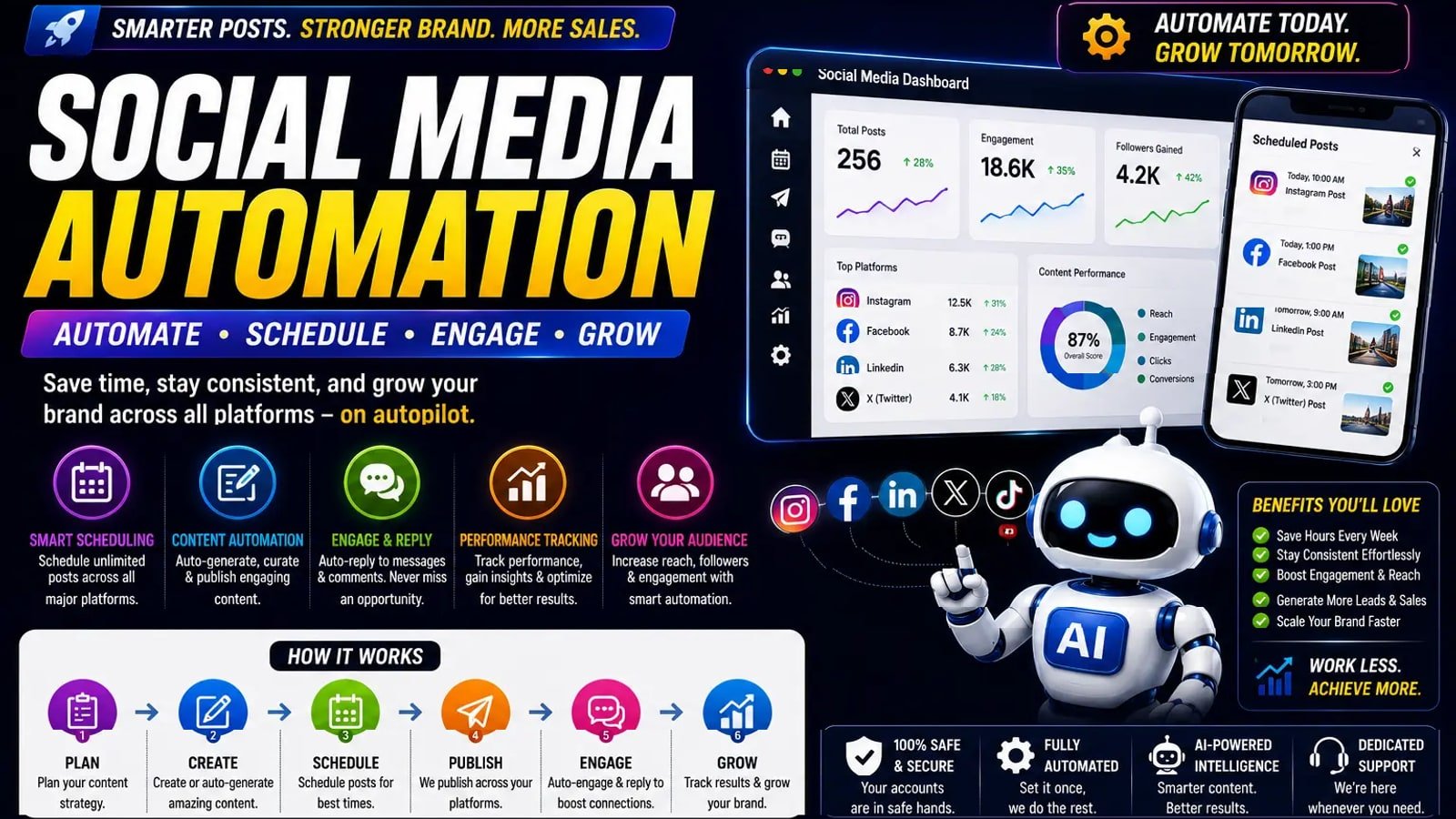
Most social media automation fails in one of two directions. Either it automates nothing that matters — a scheduling tool nobody fills — or it automates the part that should never have been touched, and the account starts sounding like software. The useful distinction is not between manual and automated. It is between the work that is mechanical and the work that carries judgment. This walks through which parts of posting are which, in the order worth building them.
Key takeaways
- Social media automation is four jobs, not one: publishing, reporting, drafting, and engagement — build them in that order.
- Start with one approved queue feeding every channel, with per-channel posting times so the same post does not land everywhere at once.
- AI drafting works when fed your own material — calls, posts, product notes. Asked for content on a topic, it produces filler.
- Never automate replies to complaints, DMs from prospects, or anything during a live problem. Keep a one-click pause on the queue.
- Route engagement rather than automating it: classify by intent, push buying signals to the CRM, let a person write every reply.
- Measure inquiries and what happened to them, not impressions — and capture the baseline before switching anything on.
The four layers, and only two are safe to start with
Social media automation gets sold as one product, but it is four separate jobs stacked on top of each other, and they carry very different risk.
Publishing is the mechanical layer: taking approved content and putting it on the right channel at the right time. Drafting is generating the content in the first place. Engagement is replying to comments and messages. Reporting is working out what any of it did.
Publishing and reporting are almost pure mechanics — there is no judgment in posting a file at 9am or in counting what happened afterward. Drafting is partly mechanical and partly not. Engagement is almost entirely judgment, which is why it is the layer that goes wrong.
Build them in that order: publishing, then reporting, then drafting, then routing for engagement. Most people start with drafting because it feels like the impressive part, and end up with a queue full of content nobody wanted to publish.
Start with the approval queue
The first thing to build is boring and it is the thing that actually changes the outcome: one approved queue that feeds every channel.
The failure it fixes is specific. Posting by hand means posting when someone remembers, which means posting in bursts when things are quiet and not at all when they are busy — the exact opposite of what you want, because busy periods are when the business has something worth talking about. A queue decouples the writing from the publishing. You approve in a batch when you have time; it publishes on schedule whether or not anyone is at a desk.
Two details separate a queue that works from one that gets abandoned. Posting times should be set per channel rather than firing everything simultaneously — the same post landing on four networks in the same minute reads as automated to anyone who follows you in more than one place. And approval has to be genuinely quick: if reviewing the week's queue takes longer than writing the posts did, nobody will do it twice.
The queue, the drafting layer and the routing described here are ordinary social media automation work — built around the channels and CRM you already use, rather than sold as another posting tool.
AI drafting works from your material, not from a topic
The difference between AI drafting that is worth having and AI drafting that produces filler comes down to what you feed it.
Ask a model for "five posts about AI automation" and you get five posts that could have come from anyone, because nothing in the prompt was yours. Feed it a transcript of a client call, a blog post you wrote, a product note, or the notes from a job you just finished, and ask it to pull three specific observations out — now the output is your material, reorganized. That version is usable after light editing. The first version is not usable at all, and publishing it is worse than posting nothing.
This is also the honest limit of the technology as it stands. It is genuinely good at reformatting something that already exists into a shorter form for a different channel. It is not good at having an opinion you have not already expressed somewhere. Treat it as a repurposing engine and it earns its place; treat it as a writer and you will spend more time fixing drafts than writing would have taken.
Set explicit rules about what it may not do: no invented statistics, no client names, no claims about results. Those rules belong in the system, not in the head of whoever is reviewing, because the whole point is that review is fast.
What to never automate
This is the shortest section and the most important one. Some things should stay human, and the cost of getting it wrong is out of proportion to the time saved.
- Replies to complaints. An automated response to someone who is angry reads as contempt, and it is public.
- Anything during a live problem — an outage, a bad review going around, a story about your industry. Queues should be pausable in one click, and someone should have that click.
- Direct messages from real prospects. This is where deals start; an auto-reply is the fastest way to lose one.
- Comments on anything sensitive: layoffs, incidents, condolences, politics. If a post needed care to write, its comments need care too.
- Follows, likes and mass outreach aimed at gaming reach. Beyond the platform-rules problem, it produces an audience that does not buy.
- Anything requiring a claim you cannot substantiate. A model will happily generate a statistic; you own it once it is posted.
Route engagement instead of automating it
The alternative to automating replies is routing them, and it is the piece most setups skip entirely.
The problem worth solving is not that replying takes too long. It is that genuine inquiries get lost among notifications. A comment saying "how much is this?" is worth more than a hundred likes, and it sits in the same inbox as the likes, on whichever of five apps it happened to arrive in.
So build the classification layer without the response layer. Everything arriving across channels lands in one place, sorted by intent: buying signals, support problems, and noise. Buying signals get pushed into the CRM as a lead with the message attached. Support problems go wherever support already goes. Noise stays noise.
A person still writes every reply. What changes is that they see the ones that matter within minutes instead of finding them a week later, and nothing that mattered gets silently dropped because it arrived on the channel nobody checks.
Measure inquiries, not impressions
Automating publishing makes it very easy to produce a lot of activity and mistake it for progress. Reporting is what stops that, and only if it measures the right thing.
Followers, impressions and likes are the numbers every platform hands you for free, and they are the ones least connected to revenue. The number that matters is how many inquiries arrived, which posts preceded them, and what happened to those inquiries afterward. That requires the routing layer above — without it there is no record of an inquiry ever existing, so there is nothing to attribute.
Set a baseline before switching anything on. Capture how many inquiries came through social in the previous quarter, however roughly. Once the automation is running, the old number is unrecoverable, and any estimate made afterward will flatter the result.
Review monthly rather than weekly. Social volume is noisy enough that a week tells you almost nothing, and reacting to weekly swings produces the erratic posting the queue was built to fix.
How these systems break
Four failure modes account for most of the disappointment, and all four are avoidable if you know to look.
The first is the queue running dry. The system publishes reliably for six weeks, the approved content runs out, and posting stops — except now nobody notices, because nobody was watching. A queue needs an alert when it drops below a week of content, or it fails silently.
The second is tone drift. Each individual AI-assisted draft is fine; twenty of them in a row average out into something bland that no longer sounds like the business. This is only visible in aggregate, which is why someone should read a month of posts together every so often rather than approving them one at a time.
The third is platform change. Networks alter their interfaces and access rules regularly, and a flow that has worked for a year can stop overnight. It is not a reason to avoid automating; it is a reason to insist on monitoring, so you find out from an alert rather than from noticing the account has been quiet.
The fourth is scale without substance. Automation makes it cheap to post more, and posting more is not the goal. If output triples and inquiries do not move, the correct response is to post less and say something worth reading — not to add another channel.
A sensible build order
If you are starting from manual posting, this sequence gets results earliest and keeps the risk at the end where it belongs.
Build the queue first and run it with content you write yourself, so the publishing layer proves itself before anything is generated. Add reporting next, with a baseline captured before it goes live. Then add drafting, fed from material you already own, with explicit rules about what it may not write. Add routing last, and stop at classification — the replies stay human.
Each step is useful on its own, which is the point. If you stop after the queue you have still fixed the consistency problem, which was probably the real complaint. Anything that only pays off once all four layers are running is a project that will be abandoned in month two.
Social is rarely the first process worth automating in a business, and it is worth knowing what it is competing with: where the highest-return automations usually sit compares the usual candidates.
Related services
Social Media Automation
We build content systems that draft, schedule, publish, and route replies across your channels — so the calendar stays full whether or not anyone remembers to post.
Explore content engineCRM Automation
We turn your CRM into an intelligent revenue engine — automated pipelines, smart follow-ups, AI scoring, and reporting that shows what to do next.
Explore crm intelligence